Contact Information
Email: suns@umbc.edu
Office: Math/Psychology 334
Phone: 410-455-3431
Fax: 410-455-1055
Lab: Sondheim 407
Lab Phone: 410-455-2934
Website: Quantitative Methods Lab
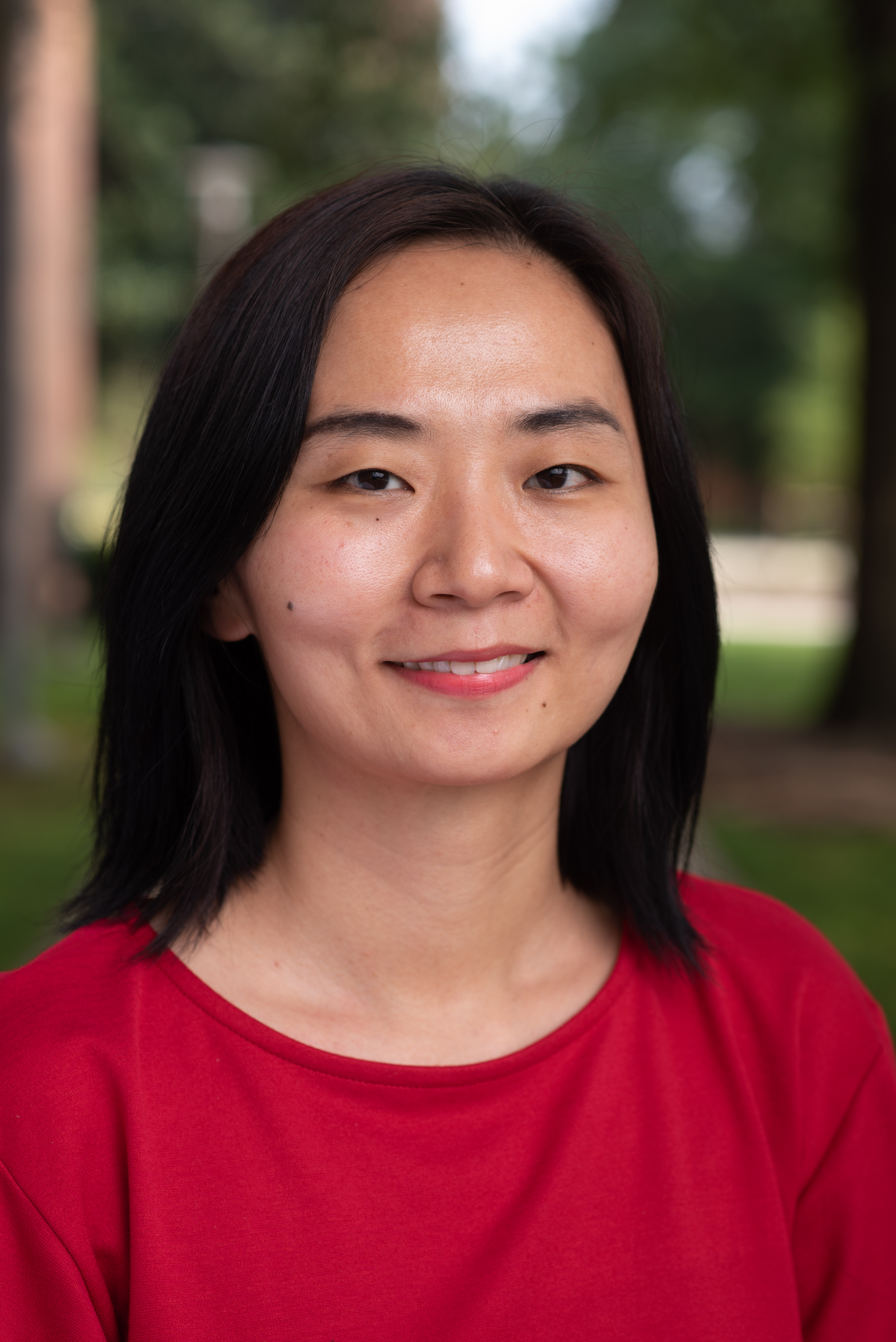
Professor
Education
Ph.D., Quantitative Research Methodology – University of Cincinnati
Area of Study
Quantitative Methods
Courses Taught
- Research Methods in Psychology I (PSYC 311)
- Experimental Psychology: Design and Analysis I (PSYC 331)
- Experimental Psychology: Design and Analysis II (PSYC 332)
- Data Analytic Procedures I (PSYC 611)
- Data Analytic Procedures II (PSYC 711)
- Measurement of Behavior (PSYC 715)
Research Interests
Dr. Sun is a quantitative research methodologist whose areas of expertise in research and teaching are focused on applied statistics, psychometrics, and their applications in the social and behavioral research. Her methodological work includes modeling longitudinal data with complex structures, using Monte Carlo methods to examine the performance of statistical models, and evaluating psychometric properties of psychological measures. With a strong interest in educational psychology, Dr. Sun also conducts research on children’s academic development in early school years, the role of school engagement in academic achievement, as well as formal and informal learning environments for science, technology, engineering, and mathematics (STEM) from K-12 to higher education.
Graduate Research and Training Opportunities
No graduate research opportunities available.
Dr. Sun would like to work with graduate students who are interested in either quantitative research methods (e.g., measurement, multilevel modeling, structural equation modeling, meta-analysis) or using quantitative methods to study important developmental issues (e.g., academic achievement, school engagement, formal and informal STEM learning environments, and learning technologies). Students will get the opportunity to work on different projects that are funded by extramural research awards. Please visit Dr. Sun’s lab to learn more about current projects.
Undergraduate Research and Training Opportunities
No undergraduate research opportunities available.
Dr. Sun’s Quantitative Methods Lab provides undergraduate students with training in statistical analyses and the opportunity to conduct independent research projects. Preference will be given to students who have taken statistics courses (e.g., PSYC 311, STAT350) and are interested in presenting at the UMBC Undergraduate Research and Creative Achievement Day (URCAD).
Graduate Program Affiliation(s)
Applied Developmental Psychology
Selected Publications
- The association between sleep dysfunction and psychosis-like experiences among college students. Andorko, ND., Mittal, V., Thompson, E., Denenny, D., Epstein, G., Demro, C., Wilson, C., Sun, S., Klingaman, E., DeVylder, J., Oh, H., Postolache, TT., Reeves, G., & Schiffman, J. (2017). Psychiatry Research, 248, 6-12.
- Racial/ethnic differences in kindergartners’ reading and math skills: Parents’ knowledge of children’s development and home-based activities as mediators. Sonnenschein, S., & Sun, S. (2016). Infant and Child Development. Advanced online publication.
- Parenting hassles mediate predictors of Chinese and Korean immigrants’ psychologically controlling parenting. Cheah, C. S., Yu, J., Hart, C. H., Özdemir, S. B., Sun, S., Zhou, N., … & Sunohara, M. (2016). Journal of Applied Developmental Psychology, 47, 13-22.
- Outcomes and Processes in the Meyerhoff Scholars Program: STEM PhD completion, sense of community, perceived program benefit, science identity, and research self-efficacy. Maton, K. I, Beason, T. S., Godsay, S., Domingo, M. S. R., Bailey, T. S., Sun, S., & Hrabowski, III, F. A. (2016). CBE-Life Sciences Education, 15, ar48.
- Multitrait-multimethod analysis of the Strengths and Difficulties Questionnaire in Asian-American preschoolers. Yu, J., Sun, S., & Cheah, C. S. L. (2016). Assessment, 23, 603-613.
- The moderating role of English proficiency in the association between immigrant Chinese mothers’ authoritative parenting and children’s outcomes. Yu, W., Cheah, C. S. L., & Sun, S. (2015). The Journal of Genetic Psychology: Research and Theory on Human Development, 176, 272-279.
- Behavioral engagement and reading achievement in elementary-school-age children: A longitudinal cross-lagged analysis. Guo, Y., Sun, S., Breit-Smith, A., Morrison, F. J., & Connor, C. M. (2015). Journal of Educational Psychology, 107, 332-347.
- Confirming the multidimensionality of psychologically controlling parenting among Chinese-American mothers: Love withdrawal, guilt induction, and shaming. Yu, J., Cheah, C. S. L., Hart, C., Sun, S., & Olsen, J.A. (2015). International Journal of Behavioral Development, 39, 285-292.
- The Children’s Depression Inventory in worldwide child development research: A reliability generalization study. Sun, S. & Wang, S. (2015). Journal of Child and Family Studies, 24, 2352-2363.
- A methodological review of statistical methods for handling multilevel nonnested longitudinal data in educational research. Sun, S. & Pan, W. (2014). International Journal of Research & Method in Education, 37, 285-308.
- Aptitude-treatment interaction effects on explicit rule learning: A latent growth curve analysis. Hwu, F., Pan, W., & Sun, S. (2014). Language Teaching Research, 18, 294-319.
- Investigating the accuracy of three estimation methods for regression discontinuity design. Sun, S. & Pan, W. (2013). Journal of Experimental Education, 81, 1-21.
- The aptitude-treatment interaction effects on the learning of grammar rules. Hwu, F., & Sun, S. (2012). System, 40, 505-521.
- Meta-analysis of Cohen’s Kappa. Sun, S. (2011). Health Services and Outcomes Research Methodology, 11, 145-163.
- The philosophical foundations of prescriptive statements and statistical inference. Sun, S., & Pan, W. (2011). Educational Psychology Review, 23, 207-220.
- Rethinking observed power: Concept, practice, and implications. Sun, S., Pan, W., & Wang, L. (2011). Methodology, 7, 81-87.
- A comprehensive review of effect size reporting and interpreting practices in academic journals in education and psychology. Sun, S., Pan, W., & Wang, L. (2010). Journal of Educational Psychology, 102, 989-1004.